a new context for the communal production, appropriation and distribution of critical knowledge

Sunday, August 05, 2007

Refugees...Until When?

1 refugee camp, 20 kids, 11 villages, 8 of which are only remnants, or not even that. These are the stats of the Birthright Replugged trip that I helped run a few weeks ago. I’m not sure where to even begin to explain the significance of this trip.

The kids are all under the age of 16 and from the Jenin Refugee camp. The city of Jenin is in fact mostly the camp, housing refugees from the ’48 Nakba. The camp is massive, and was majorly destroyed in 2002 when Israeli forces besieged the city, entirely leveled flat huge areas, killed more than 50 people, and left more than 4,000 homeless (again). Temporary tents were set up to house victims after the siege, in the same exact place as the original tents of the camp from 1948.

Many of these children have never left the camp, and for some, sadly, it will have been the only time. When they turn 16, they will get a huwiyya, an id card, and will be subject to the travel restrictions on Palestinians, which means that they will not be able to travel into ’48 Palestine, and that their travel around the West Bank will be seriously restricted, and at times cut off at the whim of the Israeli military administration. This particular group of kids are all involved in the activities of the Freedom Theatre, and their families all come from 11 villages in the north of 1948 Palestine.

So why are these called “villages of origin?” Well, first of all, these villages continue to be identity markers for these children. They all know their villages of origin, often know so many stories of those villages, and in some cases, still carry the nuanced dialects of different areas. Their families often still have the keys or the land deeds to the original houses fled from in ’48. The elders know the land like it is their own bodies, and can tell you how many meters from the house was the well, how many steps to take to get from this tree to that.

But the children? They are 3rd generation refugees, and most of them don’t know any world besides their camps. The camps, once an amassment of UN tents, are now cities, albeit rough ones made of concrete houses tightly packed together. Some of the children have been displaced in their lives too, due to home demolitions, a favoured tactic of the Israeli forces to address “security issues” which can range from collective punishment for the family (or neighbours) of a resistance fighter, to making way for settlers or army roads to accompany the apartheid wall. But these kids do not “know” their villages of origin in ’48, they have never seen them, and as I said before, most of them are amongst the more than 400 villages destroyed in ’48. So what does it mean to take kids “back” to their villages? Indeed, the rhetoric of origins and return is loaded since Zionism has used that language to talk about Jewish “return” to its “origins.”

first trip to the sea
The Replugged trip has various goals and aims. One is to just help the kids get out of the camp, to see other settings, to visit the sea, to sleep a night without the sounds of Israeli incursions. Since the adults of the camp are prohibited from traveling, this is one thing that internationals can help with. But the main goal is to creatively work towards the right of return, as it will not come just through political negotiations (this may be the last step, if it is ever possible), but through maintaining connections, and freeing those connections from the confines of the memory in the camp, to allow for the children to start developing their own dynamic relationships to their grandparents memory, and to envision what the right of return means to them, what it will look like taking into consideration the facts on the ground.

It was nothing short of appalling to be on the bus with them and to arrive to their villages, of which they may have a clear picture in their mind, and then to find that it is a dog pound, a garbage dump, a military base, a JNF forest, or a Jewish only settlement. I witnessed such heartbreaking confusion when we rolled into a modern kibbutz with swimming pools and palm trees and the kids asked, is this our village? Are these our houses? Will they be our houses again one day? In another case, in the infamous town of Ayn Hawd, where the original Palestinian houses were taken over and “maintained” by Israeli artists, while some of the refugees settled only meters away on a hill, where they can see their houses and occupiers. One of our kids from Jenin went to her grandfather’s house, now occupied by a shirtless artist who told her unthinkingly that she can come back (to visit) anytime, and another child retorted “actually she will turn 16 next year, and will be prohibited from leaving the West Bank.” This exchange is typical of a liberal Israeli attitude towards Palestinian refugees, i.e. at our convenience you can visit, so long as you are otherwise caged into your ghetto.

So how can we follow up from such a trip? The kids are working on an exhibition with the photos they took on the trip, which will debut in Jenin and then travel to the U.S. to get their stories out. Outside of Palestine, we can support Palestinians working towards the right of return. This is one of the three conditions agreed upon by over 170 Palestinian civil society organizations in their call for the international community to boycott, divest from, and impose sanctions on Israel. And for the kids? They now have a new collection of images and a new set of difficult questions to guide them in their quest for return, and they
will be the new leaders of the movement to liberate Palestine armed with their experience, dreams, and their questions that will compel them forward.


Asma drums on the site of her village of origin, destroyed in 1948

Labels: , , , , , , , , , ,

Tuesday, May 01, 2007

The Testimonies of Azmi and Hrant

"One of the difficulties in discussing violence in the 1948 war is that “Palestine,” the site of violence, both persists and has ceased to exist. Its simultaneous presence and erasure occurs in part through the survival of Palestinians from the 1948 war in what has ceased to be Palestine. Their scattered yet persistent presence constitutes a thread with which one can return to that moment when Palestine was ruined. They embody the survival of Palestine, yet also stand for its death. This death continues both to impede their memory of what has happened in 1948 and to structure it. The memories of the Palestinian survivors constitute a challenge to another kind of thread (mis)leading us back to 1948. The war also resulted in a birth—of a new Jewish state attempting to deny the simultaneous death that gave rise to its creation."
"1948: Law, History, Memory" by Samera Esmeir

I cannot help but make the connection here between Azmi and Hrant Dink, as survivors who pose a challenge by naming this connection, and really the necessity of the connection, between the death and birth. They do so in such a way that exposes as ridiculous those who try to blur the connection in order to maintain current (dis)order.

I was brought to this by c-blok’s writings, and by reading through pages and pages of writings on the Armenian genocide, some of them replete with so many forms of denial that resonate intensely with the Zionist denials of the Nakba. In his
The Ottoman Empire, 1700-1922, economic historian Donald Quataert writes that one of the main reasons why this is said to be genocide is that Armenians “died because of their identity, not because of their actions and beliefs” (185). He says this by way of introducing why he does not think it can be called genocide, why it was different than the Nazi genocide of Jews. I wonder, in what ways? How is it possible to divorce identity from actions and beliefs?

He locates the beginning of the problems, where “the story begins,” in 1914 with Russian Armenians who come along with other Russian invaders through the eastern Anatolian front. This follows an entire book which actually quite carefully and thoroughly maps the various ways in which Ottoman identities were formed over centuries, and changed and disrupted suddenly with the Tanzimat. In this way, we can see how the story begins much earlier in fact, in the way that Armenian identity, not just as a national identity but as an identity of the second largest millet in the Ottoman Empire, made them the exact targets for actions focused on cleansing and consolidating, incidental only insofar as the people killed were bodies that incidentally belonged to that identity. This is the same with Jews in the Nazi holocaust and Hannah Arendt does a very nice job showing this in
The Origins of Totalitarianism by looking at how the Jew (rather than the Jews) played a very specific and very complex role in commerce and in social relations in Europe, and that it is not a coincidence that the “liberation” of the Jew ultimately led to the destruction of the Jew.

Quataert reports that in Istanbul and Izmir the Armenian communities “remained intact and in place, going about their business” (186) while the massacres were conducted in the East, i.e. that the absence of large-scale massacres in Istanbul and Izmir cancel out the massacres in the East. This is a position also taken by Zionist denialists, saying that some Arabs (Palestinians) did not leave (weren’t expelled from) their homes in 1948, and that some were even saved by Jews! This ugly rhetoric asserts that the exceptions prove the rule, and that if there was no killing of bodies, or rather, if all bodies were not killed, then a genocide did not take place.

What is similar in both situations, and why the term genocide is apt, is that the mass killing was not just the murder of people, but an effort to eradicate Armenian or Palestinian identity as such, so that those who remained would not be Armenian or Palestinian. The presence of Armenians in Turkey or the presence of Palestinians in Israel highlights this: as identities which experienced the genocide through survival, that is, a survival which became an extension of the genocide, their presence becomes a testimony. But a testimony to what?

The presence and the testimony of Hrant Dink and of Azmi Bishara stand both for survival and death, and this is precisely how genocide functions. It is not just the killing of people, as though that would not be enough, but more so, the structuring of that killing, not because it is premeditated or it uses modern technology, but because it is designed to kill an identity in order to make way for another. We are supposed to believe in the compassion of Zionism and/or Kemalism because it “allowed” for some Palestinians or Armenians to live, and even to stay in their home territories, but even those few who got to stay in the same house, were de-territorialized in a way that was just as violent. The process was to expel some out of their homes, and for the others, to expel their homes out of them, to make them strangers in themselves(as Azmi writes in his recent LA Times editorial: “When Israel was established in 1948, more than 700,000 Palestinians were expelled or fled in fear. My family was among the minority that escaped that fate, remaining instead on the land where we had long lived. The Israeli state, established exclusively for Jews, embarked immediately on transforming us into foreigners in our own country.”), to disorient them in such a way that it is not clear what home or identity even mean, and then to have them serve as the proof that genocide did not occur.

The power and the threat of Hrant Dink and of Azmi Bishara, and of all of the Armenians in Turkey and Palestinians in Israel, is that they refuse to be that proof, that they transform that survival from an individual bodily survival to a collective resistance.

Labels: , , , , , , ,

Friday, April 27, 2007

The expansive politics of Azmi Bishara and Emily Jacir

In his recent book-manifesto, Hatred of Democracy, Jacques Rancière refers to citizen's rights as the "rights of those who have not the rights that they have and have the rights that they have not." Politics is sparked within the interval of this contradiction as the 'have nots' defy, through political practice, the arbitrary deprivation of the rights that they have. This is at least how I understand Rancière's attempt to politicize the citizenship discourse and recover its radical dimension that is lost in the hands of both its critics and advocates.

The critics' apathy emanates from a certain circular deadlock that they think to inhere in the rights discourse: by its very definition, human rights are the rights of those (or for those) who have no rights. Conceived this way, rights discourse delivers nothing but a mere tautology. On the other hand, the advocates, in regarding the universality of the rights discourse as self-evident, remain oblivious to the internal exclusions that particularize the latter within the citizenship practices.

For Rancière, then, both advocates and critics would obfuscate the site of the political by sidestepping the divisibility of rights. That is, they would overlook the ways in which a new subjectivity could be established through countering the internal exclusions of the rights discourse via holding it accountable to its very pronouncements. Perhaps, it is the bringing into existence of this political site in the context of Israel that gives Azmi Bishara's position its profound uniqueness. (Thanks to entropy, the destroyer and viola swamp for acquainting me with Bishara and the wonderful documentary, I Also Dwell Among Your Own People: Conversations with Azmi Bishara by Ariella Azoulay.)

From 1996 until his recent resignation, Bishara has been a member of the Israeli parliament (Knesset) and the key founder of the political party, the National Democratic Assembly (NDA-Balad), represented by 3 (now 2) seats in the 120 member Knesset. Bishara's controversial position stems from his persistence in pointing out the divorcement of the Israeli citizenship from its declaration, an exercise that violently figures in the denial of citizenship rights to the Israeli Arabs and Palestinians who have them. Rather than advocating for a separate nation-state for the Palestinians, Bishara and his party have insisted on reclaiming what they already have, Israeli citizenship.

In this sense, Bishara's position not only compels the Israeli state to face up to its disavowal of the principles of citizenship, and, hence, the intimate self-annihilation that resides at the core of its identity. It also restores the universalizing aspiration to the principle of citizenship against the process of the latter's privatization and particularization through the formation of ever newer nation-states. It is dire, and, unfortunately, not so surprising, that Zionism's anxious reaction to Bishara's position has been to clamp down on the Arab minority, the "enemy within." His recent resignation and exile come as a result of this increasing assault.

***

The photograph below by the diaspora/Palestinian artist Emily Jacir is entitled Bank Mirror, Ramallah. I do not know what makes this image so intriguing to me. I cannot but keep looking at it. Maybe, because I have grown so accustomed to associating Palestine with images of beige streets that look like war trenches, a wall-torn stony landscape punctuated with naked dwellings. Does this image remind me that there are actually banks in Palestine, which somehow 'function', that there is a modern urban life in shambles?

Or is this art work captivating because of the way in which it positions itself? That is, the way in which it does not forefront, frame, or try to carve out a space for itself, a separate realm for art, but rather merges with the social field of Palestine, letting itself "disappear" within what it offers: in Susan Buck-Moss' description of public art, "a protective exposure," "a safe place in the public sphere" for the unspeakable truths. In a sense, there is a certain innocence to the image that, in its refusal to deliver the familiar representation of 'the enemy', snatches the enjoyment of the reactionary common sense. After all, the image does not portray an easily identifiable Subject of resistance in revolt, but rather a shattering effect of the occupation that remains ineffable.

But what is this effect, the unspeakable truth within which this art work dissolves? Is the shattered mirror a witness to, an almost perfect reflection of the fact that there is nothing left anymore in Palestine to represent (or representable in some meaningful way), say, apart from its completely destroyed public life and its mutilated past? I want to suggest that what the image disseminates exceeds this realist and desolate insinuation. The image embodies a dimension of desacralizaton, destablization, a process of emptying out fantasies (how would the 'holy lands' of Israel reflect in this mirror? how would a Zionist appear in this mirror?) even though such a desacralizing aspect emerges as an effect of a violence imposed on a population.

Yes, the image does not offer a resolution; it does not guide a way out of the apartheid violence. Yet, the image does not quite close off onto itself; its cracks render palpable the impossibility of making essentializing identity claims on this geography. Maybe, it is the void and the cracks of the Palestine-Israeli social formation that this image moves toward. Elaboration of the politics of void, which, in part, is inspired by xurban collective's reconceptualization of art as archeology, is left for other surplus thoughts.

Labels: , , , , , , , ,

Friday, January 19, 2007

Hrant Dink's solitude

Hrant Dink, an Armenian editor, columnist, journalist, thinker from Turkey is assassinated yesterday. Within left progressive and pro-democratic forces in Turkey, Dink occupied a unique place. His perseverance, especially, in the face of the travesty of unending court trials and delusory accusations he was subjected to, more recently under the infamous Article 301, evokes an admiring and a guilty puzzlement. Unfortunately, it is Dink's loss that compels this state of puzzlement into a deliberation of the immense significance and singularity his position embodied.

Dink struggled against the nationalist denialism around the Armenian genocide and discrimination of Armenian community in Turkey (whose numbers dwindled to something between 50.000-80.000). However, he refrained from simply advocating "positive rights" for the Armenians, an approach that he argued to have led to the isolation of the Armenian community as a minority that needs (international) protection. Rather, he assumed a "negative rights" approach, meaning, he revealed the exclusions of Turkish citizenship at the same time that he engaged in practices of constituting the excluded Armenian community as citizens of Turkey. By remarking on the general precariousness of rights in Turkey, he also pointed to the shakiness of the majority/minority distinction. I think such interventions universalized Dink's position beyond the defense of Armenian rights to addressing more broadly the important issue of rethinking of citizenship in Turkey.

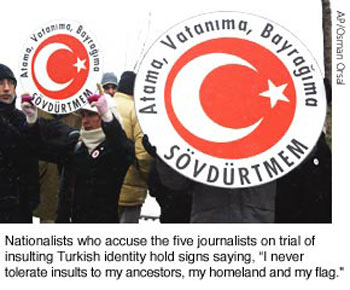
With equal commitment, Dink critiqued the politics of ressentiment that continues to structure the Armenian identity. He was at times critiqued by certain tendencies within the Armenian community, the religious institution of Patriarchy in Turkey as well as by the Armenian state and segments of diaspora. His nuanced stances were regarded too controversial or wrongly equated to the assimilation of the Armenian identity. Thus, on the one hand, his position was not quite fully embraced and remained inarticulate. On the other hand, he was tortured at the hands of Turkish nationalism for "denigrating and insulting Turkishness," and, eventually, eliminated. This solitude of Hrant Dink attests to the fact that he was the voice and living practice of some truth, which was hard to assume and digest, but all the more necessary not to be lost.

In the aftermath of the killing, the politico-legal-military state apparatus in Turkey circulates the memorized narratives of condemnation and condolence. Military general Yaşar Büyükanıt's awaited statement, "today's bullets were targeted to Turkey," finds its reflection in the familiar rhetoric of the prime minister, Tayyip Erdoğan, "the dark hands that killed him will be found and punished." These soulless declarations shoulder each other to reduce Dink's murder to an affair of national security, at the same time, repressing and subtracting the responsibilities of the establishment from its eventuating. They forestall the acute need to understand why this event happened. Performing a feigned remorse, they try to suppress the obscene fact that it was only a few days ago that Dink himself was ruthlessly attacked as being part of those dark forces, for allegedly threatening national unity and solidarity.

Clearly, the "Turkey" that the nationalist state ideology imagines to be targeted by yesterday's bullets has nothing in common with Dink's understanding of "Turkey." This is the reason why he is murdered. This is the reason why he walked the courts for three years before his first acquittal from the charges of insulting "Turkishness," because he defined himself in some conference in 2002 as being "not a Turk, but from Turkey and Armenian."

Dink's claim inspires a notion of citizenship, whose attachment is to a certain place and geography, rather than to a pure identity. Yet, there is also a certain understanding of historical attachment that flows through such a material space, which Dink did not want let go of. This history, though, does not correspond to a recuperation and keeping alive some lost (Armenian) ideal. Indeed, while Dink claimed that he was an Armenian and from Turkey, and while he fervently criticized the Turkish official history, he also repeated the need to detach the Armenian identity from the weight of historical memory, the "residues of the past," and, instead, refocus on the living Armenian community.

Reading Dink's claim "being from Turkey and an Armenian" might also call forth another historico-spatial imagination of Turkey, more properly, of Anatolia, as 'the mosaic of cultures,' a prevalent multiculturalist idea of citizenship that both progressive and conservative thinking at times embrace as an alternative to the ethnocentricism of Turkish nationalism. In this ideology, Turkish citizenship encompasses many different cultures, and identities, Turkish, Kurd, Armenian, Greek, Cherkes, Abkhaz, and so on. I think that Dink's position was far from such an ideal of reinserting into contemporary context previously defined and bounded identities that were presumed to once coexist harmoniously in Anatolia. It rather seems to me that what Dink's unique and dangerous project embodied was reclaiming and redefining an Armenian identity as an intimate condition of redefining what it means to be a citizen of Turkey and vise versa. Agos, the bilingual newspaper that Hrant Dink established is perhaps one such new space, one of the main institutions for such a reconstruction and reclaiming. While Agos will continue its life, it is not so certain that Hrant Dink's place will be filled.

Labels: , ,