The Testimonies of Azmi and Hrant
"One of the difficulties in discussing violence in the 1948 war is that “Palestine,” the site of violence, both persists and has ceased to exist. Its simultaneous presence and erasure occurs in part through the survival of Palestinians from the 1948 war in what has ceased to be Palestine. Their scattered yet persistent presence constitutes a thread with which one can return to that moment when Palestine was ruined. They embody the survival of Palestine, yet also stand for its death. This death continues both to impede their memory of what has happened in 1948 and to structure it. The memories of the Palestinian survivors constitute a challenge to another kind of thread (mis)leading us back to 1948. The war also resulted in a birth—of a new Jewish state attempting to deny the simultaneous death that gave rise to its creation."
"1948: Law, History, Memory" by Samera Esmeir
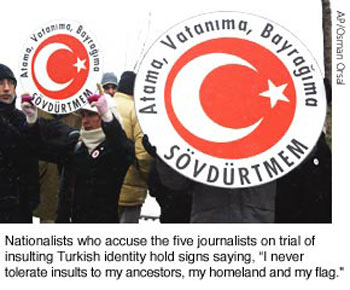
I cannot help but make the connection here between Azmi and Hrant Dink, as survivors who pose a challenge by naming this connection, and really the necessity of the connection, between the death and birth. They do so in such a way that exposes as ridiculous those who try to blur the connection in order to maintain current (dis)order.
I was brought to this by c-blok’s writings, and by reading through pages and pages of writings on the Armenian genocide, some of them replete with so many forms of denial that resonate intensely with the Zionist denials of the Nakba. In his The Ottoman Empire, 1700-1922, economic historian Donald Quataert writes that one of the main reasons why this is said to be genocide is that Armenians “died because of their identity, not because of their actions and beliefs” (185). He says this by way of introducing why he does not think it can be called genocide, why it was different than the Nazi genocide of Jews. I wonder, in what ways? How is it possible to divorce identity from actions and beliefs?
He locates the beginning of the problems, where “the story begins,” in 1914 with Russian Armenians who come along with other Russian invaders through the eastern Anatolian front. This follows an entire book which actually quite carefully and thoroughly maps the various ways in which Ottoman identities were formed over centuries, and changed and disrupted suddenly with the Tanzimat. In this way, we can see how the story begins much earlier in fact, in the way that Armenian identity, not just as a national identity but as an identity of the second largest millet in the Ottoman Empire, made them the exact targets for actions focused on cleansing and consolidating, incidental only insofar as the people killed were bodies that incidentally belonged to that identity. This is the same with Jews in the Nazi holocaust and Hannah Arendt does a very nice job showing this in The Origins of Totalitarianism by looking at how the Jew (rather than the Jews) played a very specific and very complex role in commerce and in social relations in Europe, and that it is not a coincidence that the “liberation” of the Jew ultimately led to the destruction of the Jew.
Quataert reports that in Istanbul and Izmir the Armenian communities “remained intact and in place, going about their business” (186) while the massacres were conducted in the East, i.e. that the absence of large-scale massacres in Istanbul and Izmir cancel out the massacres in the East. This is a position also taken by Zionist denialists, saying that some Arabs (Palestinians) did not leave (weren’t expelled from) their homes in 1948, and that some were even saved by Jews! This ugly rhetoric asserts that the exceptions prove the rule, and that if there was no killing of bodies, or rather, if all bodies were not killed, then a genocide did not take place.
What is similar in both situations, and why the term genocide is apt, is that the mass killing was not just the murder of people, but an effort to eradicate Armenian or Palestinian identity as such, so that those who remained would not be Armenian or Palestinian. The presence of Armenians in Turkey or the presence of Palestinians in Israel highlights this: as identities which experienced the genocide through survival, that is, a survival which became an extension of the genocide, their presence becomes a testimony. But a testimony to what?
The presence and the testimony of Hrant Dink and of Azmi Bishara stand both for survival and death, and this is precisely how genocide functions. It is not just the killing of people, as though that would not be enough, but more so, the structuring of that killing, not because it is premeditated or it uses modern technology, but because it is designed to kill an identity in order to make way for another. We are supposed to believe in the compassion of Zionism and/or Kemalism because it “allowed” for some Palestinians or Armenians to live, and even to stay in their home territories, but even those few who got to stay in the same house, were de-territorialized in a way that was just as violent. The process was to expel some out of their homes, and for the others, to expel their homes out of them, to make them strangers in themselves(as Azmi writes in his recent LA Times editorial: “When Israel was established in 1948, more than 700,000 Palestinians were expelled or fled in fear. My family was among the minority that escaped that fate, remaining instead on the land where we had long lived. The Israeli state, established exclusively for Jews, embarked immediately on transforming us into foreigners in our own country.”), to disorient them in such a way that it is not clear what home or identity even mean, and then to have them serve as the proof that genocide did not occur.
The power and the threat of Hrant Dink and of Azmi Bishara, and of all of the Armenians in Turkey and Palestinians in Israel, is that they refuse to be that proof, that they transform that survival from an individual bodily survival to a collective resistance.
Labels: armenian genocide, azmi bishara, hrant dink, Nakba, Palestine, post-nationalism, testimony, the middle east
posted by Anonymous at 2:26 PM
|
0 comments